"2013 is the worst year for Agrarian Reform,” says João Paulo Rodrigues Chaves
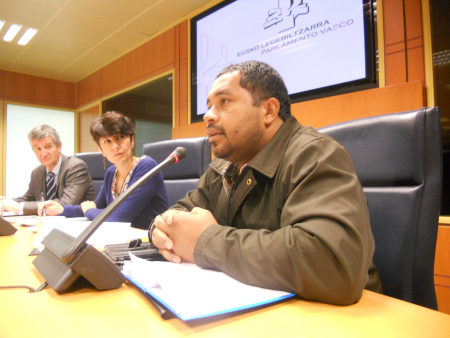 The year 2013 won’t be missed by the Landless throughout the country. Regarding the struggle for land, the balance is positive, due to the demonstrations, marches and occupations of land and public buildings that occurred almost throughout the year.
But when referring to Agrarian Reform policy, almost nothing has been done, and in many cases the government walked backwards. This is the assessment of João Paulo Rodrigues Chaves, from the national coordination of the MST, on the agrarian policy stimulated by the federal government during all of this year.
As Rodrigues stated, something that has always been bad in this government became even worse. “So far, only 159 families were settled around the country. It's a shame. There were 10 properties expropriated by the Dilma government. Worse than the last military government of General Figueiredo, when 152 properties were expropriated," he says.
Check out the interview:
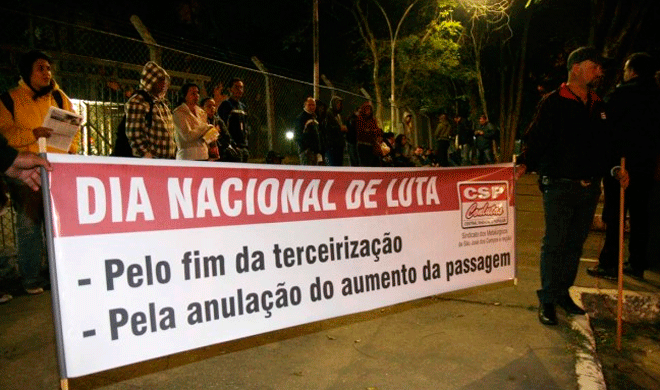 of Struggle. Called for by CUT (Central Workers Union), an assortment of labor unions and a vast array of social movements, including the MST, the National Day of Struggle put forth specific demands for the working class and social movements, including a call for agrarian reform. The MST participated and helped lead this mobilization through the country.
 The MST will be included in the mobilization of trade unions, social movements and political organizations of the working class to take to the streets of the country, on Thursday (July 11), to defend a political platform, with the reduction of working hours, investment of 10% of GDP for health and education, free and quality public transport, the democratization of the media and the implementation of land reform.
 Seventeen years have passed since that fateful April 17. On that day in 1996, a march of rural workers organized by the MST was blockaded and attacked by military police in the city of Eldorado dos Carajás, Pará state. 19 people were killed on the spot and 2 others died days afterwards. The day of the Eldorado dos Carajás massacre has officially become the National Day of Struggle for Land Reform.
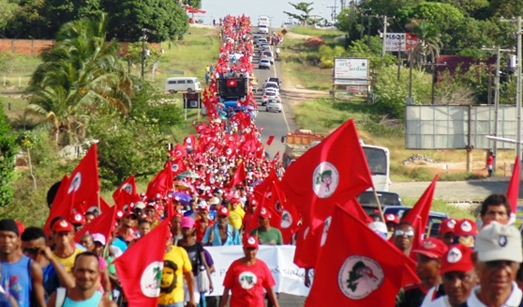 by Wesley Lima
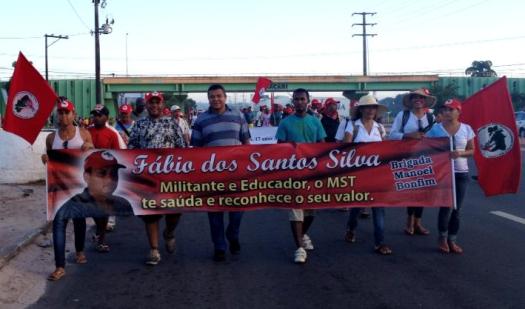 MST leader Fábio Santos da Silva, assassinated on April 2 by 15 shots fired by gunmen in Iguaí, in the Southwest of Bahia, was buried on April 3.
  Under the Brazilian Constitution, landless families have the right to occupy arable land that is not being used in order to grow food to feed themselves.
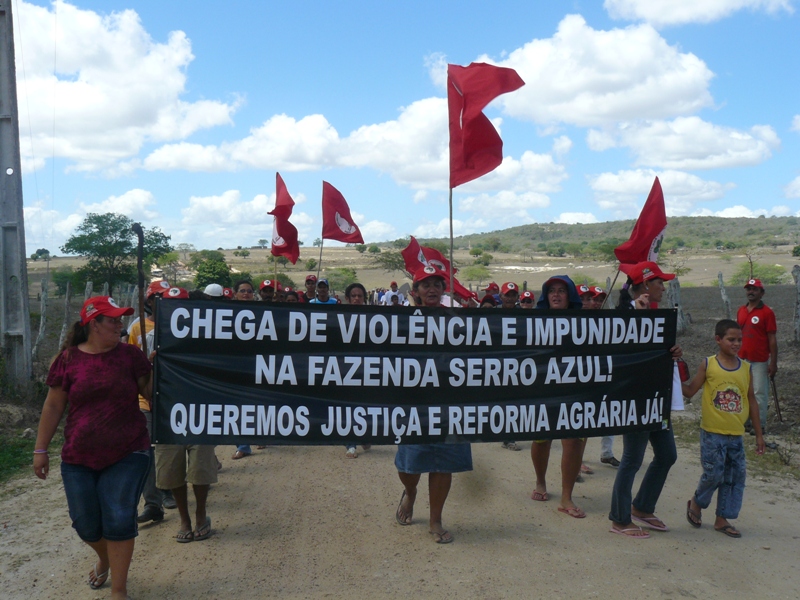 Representatives of the State Secretariat for Human Rights, the State Program for the Protection of Human Rights Defenders and the Ombudsman of the Department of Social Defense visited, on Tuesday (July 3, 2012), the Gregório Bezerra encampment in the city of Altinho, rural Pernambuco (PE).
 Dear Friends of the MST,